Start with a product-and-hardware assembly suited to the actual splash and water-contact conditions. “Marine grade” alone is not a complete specification.
Next decision: Separate spray from immersion, then resolve the exact connector and fastener combination before the board profile and takeoff.
Keep in mind: Do not infer saltwater suitability from a species name or the word stainless.
Three exposure questions for a waterfront dock
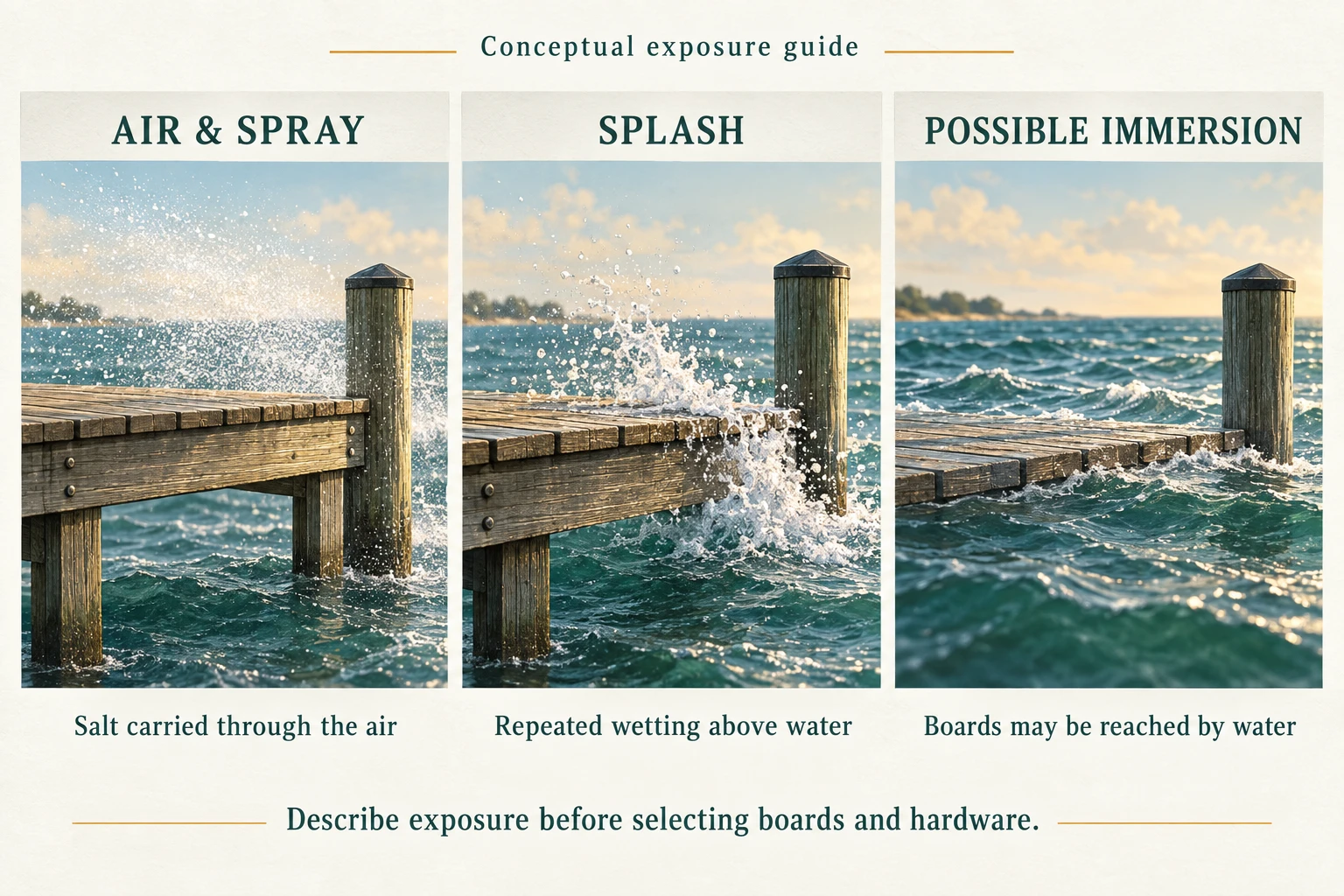
Read the infographic as text
- Air and spray: record whether salt is carried through the air to the assembly.
- Splash: describe repeated wetting above the ordinary water surface.
- Possible immersion: identify whether water may reach the boards; seek product-specific application guidance.
- Describe the exposure before selecting boards, fasteners and connectors.
Describe the exposure before choosing the material
“Near saltwater” can describe a sheltered residential dock, an exposed marina walkway, or a deck repeatedly reached by waves. Those are different project briefs. Record whether the proposed decking is above ordinary water levels, subject to splash, or likely to experience intermittent immersion. Include tidal range, storm exposure and whether freshwater rinsing is practical. A photograph taken on a calm afternoon cannot establish the worst conditions the assembly will encounter.
Separate observed conditions from assumptions. Mark the water level and weather when photographs were taken. Ask the owner which areas remain wet, where salt deposits accumulate and whether debris collects underneath. If the project has no operating history, give the designer the uncertainty rather than replacing it with a confident label. A supplier can respond more usefully to a defined exposure description than to “marine grade required.”
Make the hardware schedule part of material selection
A board choice does not approve its fastening system. Identify the proposed screw or clip, the supporting framing material, the connector at the same joint and any coatings or metal interfaces. Ask for a written application recommendation that addresses the chloride exposure you described. The recommendation should identify the exact products; a generic stainless-steel description leaves alloy, dimensions and connector compatibility unresolved.
USDA research identifies moisture as an important factor in corrosion of metal fasteners embedded in wood. It does not approve a particular alloy for every dock. Mechanical requirements still matter, including the fastener geometry, installation method and compatibility with the connector and substrate. Keep the product documentation with the drawings so substitutions can be checked against the same basis.
- Exposure description, including splash and possible immersion
- Exact board profile and supporting material
- Fastener and connector manufacturer references
- Written confirmation of compatibility for this assembly
Plan for drainage, access and replacement
Think through how water leaves the upper surface and how the underside can dry. Check areas around borders, utility runs, attachment plates and transitions where debris might restrict drainage or inspection. A drawing that shows only the visible board surface leaves these interfaces unexplained. Provide sections through representative connections and through the least accessible edge.
Make future repair practical. Ask whether a damaged board can be removed without taking apart a large surrounding area, how the underside will be inspected and where maintenance personnel can work. For a floating dock, changes in decking weight belong with the designer’s review of the complete floating assembly. This guide does not determine flotation, wave loading or structural capacity.
Evaluate the surface in its intended use
Saltwater exposure is not the only material decision. List barefoot traffic, boat equipment, carts, cleaning access and the owner’s appearance expectations. Evaluate a representative sample for texture and visible finish. A hand sample helps discuss these qualities, but does not reproduce a weathered, wet, contaminated or sun-heated installed deck. Where a project needs a defined slip-performance criterion, obtain a suitable test method and product evidence through the project professional.
Record which observations came from the sample and which came from a supplier document. Do not translate “feels grippy” into a slip rating or a species description into a guaranteed lifespan. This keeps the comparison honest and gives the owner an understandable basis for deciding between alternatives.
Prepare a request that can be answered
Attach a dimensioned layout, your exposure notes, intended board direction and the known framing details. Identify outstanding approvals rather than implying that a material inquiry is a construction approval. Ask the supplier to identify actual dimensions, available product documentation, compatible hardware and the scope included in its response. Keep quantities marked preliminary until the selected product and layout have been reconciled.
Continue through fastener compatibility before calculating a final material request. If the fastener system changes the required profile or support arrangement, that change can affect the board layout and takeoff. The sequence below is designed to resolve those dependencies in a useful order.
Worked planning example: two exposures on one dock
Consider an illustrative project with a sheltered shore connection and an outer platform exposed to regular spray. This is a planning example, not a completed customer project. The owner originally describes the whole dock as “saltwater.” A more useful brief marks the outer platform separately, records where water and salt deposits are observed, and identifies the underside connections that are difficult to reach.
The team can now ask whether one documented hardware system is appropriate across both zones or whether the connection schedule needs separate details. That is a question for the selected manufacturers and project professional, not a conclusion that the exposed zone automatically needs an invented hardware upgrade. The benefit of zoning is that the most demanding condition cannot disappear inside a broad site description.
Next, the board layout identifies an access opening on the outer platform. Before selecting concealed clips, the installer explains how that opening and an adjacent damaged board could be removed later. If the proposed system requires inaccessible underside work, the team revisits the detail before procurement. Neither the species name nor the exposure label would have revealed this maintenance problem on its own.
Can I choose the wood first and solve the screws later?
You can identify a preferred material early, but keep the selection provisional until its profile and fastening system are coordinated. A square-edged board and a system requiring a specific groove are different procurement descriptions. Changes in profile, support or connection details can affect the layout and the final material request.
Ask for the product and compatible attachment references together. That does not require the owner to become a fastener specialist; it gives the installer and supplier a shared set of identified components to review.
Research on moisture and corrosion of metals embedded in wood. Not a saltwater alloy approval or a product-specific connection schedule.
General wood science. Does not establish a spacing schedule, structural span, or performance guarantee for a supplied decking product.
Regional British Columbia guidance. Useful environmental questions, not a universal construction code.